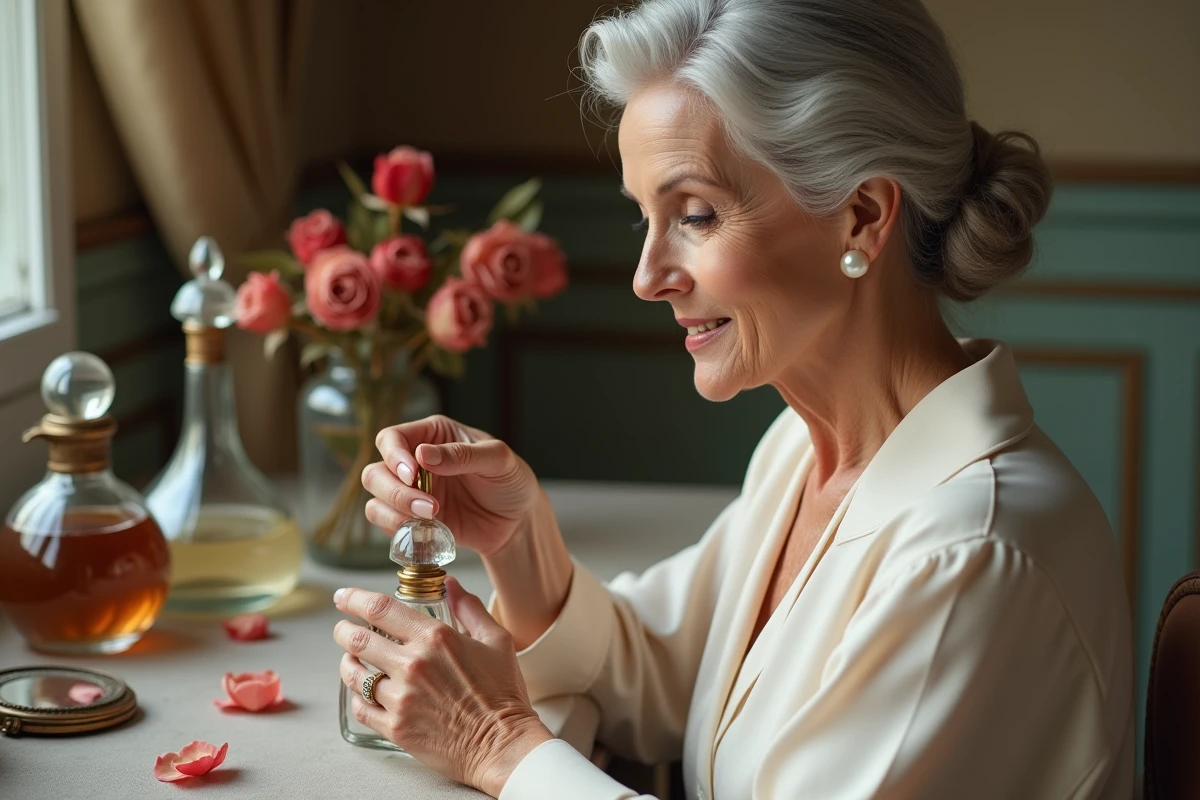
After several decades of loyalty to a bottle, or conversely after a long period without perfume, the choice of a fragrance at 70 no longer meets the same criteria as at 30 or 50. The skin retains molecules differently, tolerance to highly concentrated compositions may decrease, and the formulations of the classics themselves have changed due to recent regulations.
Asking about perfume for a 70-year-old woman means navigating these three realities at once.
IFRA Reformulations: Why Your Classic Perfume No Longer Smells the Same
The successive restrictions from IFRA (International Fragrance Association), particularly the 51st and 52nd amendments published between 2022 and 2024, have targeted several allergens present in historical compositions. Oak moss derivatives and certain musks, cornerstones of chypre and oriental families, are the most affected.
The concrete result: a Mitsouko or a Clinique Aromatic Elixir purchased today no longer delivers the same signature as those discovered in the 1970s or 1980s. Reformulated chypres often appear softer and less tenacious than their original versions. This is not a matter of quality; it is a regulatory constraint.
For a woman accustomed for decades to a specific trail, this discrepancy is destabilizing. Before seeking a new perfume, it is worth knowing if the one she still wears exists in a version close to the one she loved, or if she needs to accept turning the page. Asking what perfume for a 70-year-old woman often means navigating between nostalgia for a vanished formula and discovering current alternatives.
Skin Tolerance and Light Concentrations: A Fundamental Trend in Perfumery
In recent years, several major houses have reported a growing demand for lighter versions of their best-sellers, partly driven by a senior clientele. The reasons are physiological: respiratory discomfort, migraines triggered by overly concentrated scents, increased skin sensitivity.
Lancôme and Chanel have mentioned in their communications a particular focus on tolerance and controlled sillage for senior clients. The L’Oréal 2023 activity report (Luxury section) mentions this shift. Fresh waters and light eaux de parfum meet a need for comfort, not a renunciation of perfume.
Choosing a softer concentration (eau de toilette, eau fraîche) rather than an extract or perfume is not a concession. It is a logical adjustment when the skin and sense of smell have evolved. Applying on clothing rather than directly on the skin can also extend longevity without causing irritation.
Olfactory Families to Explore After 70: Beyond Powdery and Floral
Competitors on this topic consistently point towards three families: powdery, heady florals, classic chypres. These avenues remain valid, but they confine 70-year-old women to a narrow repertoire, often tied to an era rather than personal taste.
Citrus and Woody, Rarely Mentioned
Citrus compositions (bergamot, lemon, neroli) offer a freshness that works very well on mature skin. They do not saturate the space, do not cause respiratory discomfort, and their lightness does not prevent a true olfactory personality when the base rests on cedar or vetiver.
A woody-citrus perfume can advantageously replace a reformulated chypre whose longevity has diminished. The woody family, long associated with masculine fragrances, has widely opened up in recent years with mixed compositions that appeal to all generations.
Aldehydic Florals: A Balance Between Classic and Modernity
Aldehydes give florals that almost metallic, airy dimension, which characterizes perfumes like Chanel N°5 in its original version. Aldehydic florals remain among the most balanced compositions for everyday use: neither too heavy nor too fleeting.
However, here too, reformulations have affected certain references. Testing on skin before purchasing remains the only reliable method to assess the actual longevity of a perfume in its current version.
Concrete Criteria for Choosing a Perfume After 70
Rather than a list of perfume names (which become obsolete with the next reformulation), here are the criteria that withstand the test of time:
- Longevity on fabric: if the skin no longer retains notes as before, spraying on a scarf made of natural fibers (silk, cotton, wool) prolongs the fragrance for several hours without direct skin contact.
- Proximity sillage: at 70, a perfume that can be sensed from a meter away is more than sufficient. Compositions with controlled sillage avoid the “perfume aisle” effect that loved ones may find overwhelming.
- Compatibility with skincare: some scented moisturizers or dermatological treatments interact with base notes. Applying perfume after skincare, on a different area, limits interference.
- Purchase format: small-sized bottles or samples allow testing over several days before committing to a full bottle, especially when discovering a new olfactory family.

Niche Perfumery and Seniors: A Market Still Underexplored
Niche perfume brands (Diptyque, Serge Lutens, Frederic Malle, among others) often work with raw materials less affected by IFRA restrictions or offer custom concentrations. Their senior clientele exists, but it remains poorly targeted in the communication of these houses.
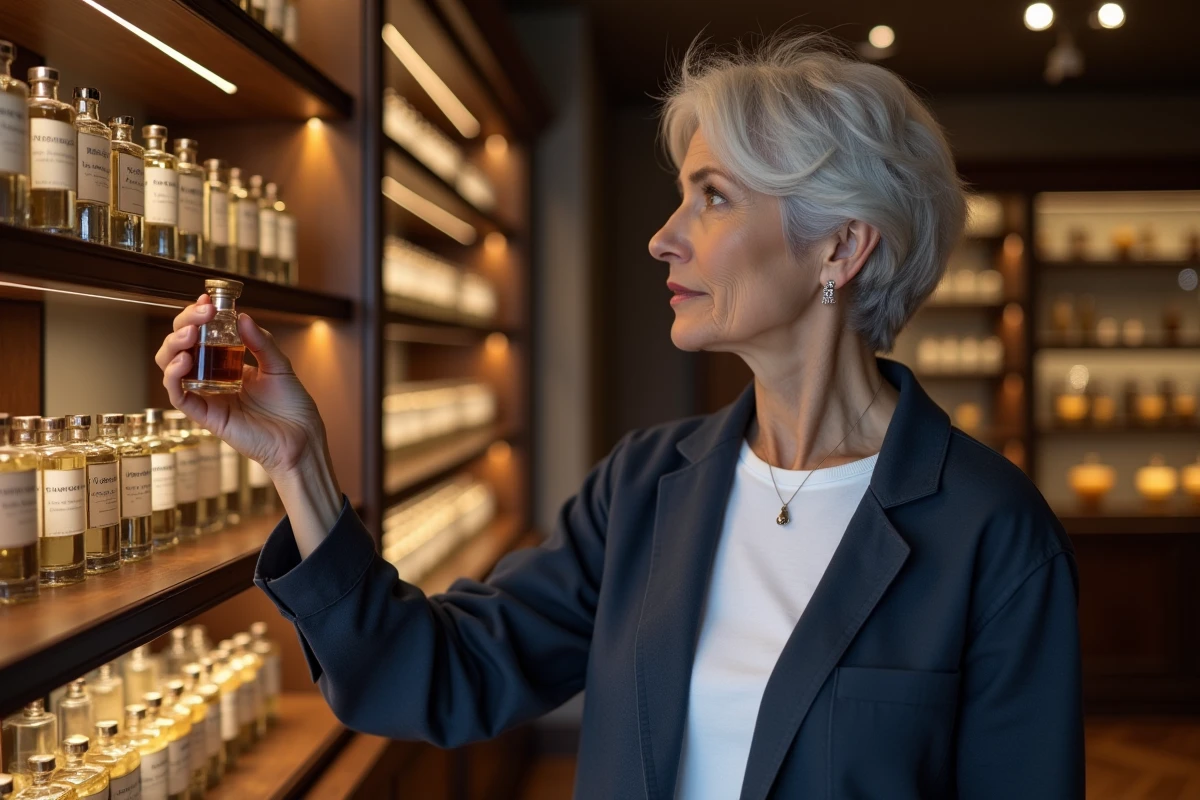
Niche boutiques offer personalized olfactory support that large retailers cannot always provide. The time spent smelling, testing, and returning is part of the process, and niche perfume advisors are trained to guide without imposing.
Field feedback varies on this point: some 70-year-old clients find these boutiques intimidating or too far removed from their olfactory references. Others discover compositions that completely renew their relationship with perfume. The welcome and pedagogy of the salesperson make all the difference.
Choosing a perfume at 70 is not just about picking from a list of “classics for seniors.” The skin has changed, the formulas have too, and alternatives exist well beyond the traditionally recommended families. Testing over several days, prioritizing olfactory comfort, and accepting that a beloved perfume for forty years may be replaced by an unexpected discovery: this is probably the only method that holds true.